The film – and this may disturb as many viewers as it satisfies – is not much about how these operatives were feeling.
“What is more interesting for me as a journalist and a film-maker is to investigate the opposite question: how can you do that and not feel regret?” Abraham says. “How can you do that and continue doing that? This is not shooting and crying, which is a genre of Israeli film. This is shooting and not crying.”
Naza packs an enormous amount of information into its 77 minutes. A good portion of the film is about a computer program, called Lavender, that assists operatives, all at a safe distance, to select supposedly legitimate targets.
The film – and this may disturb as many viewers as it satisfies – is not much about how these operatives were feeling.
“Lavender is an AI-based program that gave almost every individual in Gaza who has a phone a rating of one to 100 that indicates how likely it is that this individual is a member of the
Hamas or Islamic Shia military wings,” Abraham says.
“The film really goes into the details we uncovered in the past in our investigative reporting about how it works and how this AI system makes decisions.
“Soldiers speak about how it had an error rate. The Israeli army knew that in some cases they were marking people who had similar patterns to a Hamas operative but were not actually Hamas operatives.”
Abraham speaks about a baker whose premises were near a Hamas training compound. He may have had numbers for Hamas operatives in his phone, but he was not a member.
“You could see how it could mark this person as a target,” he says. “People marked by Lavender – just generally people who would be suspected of being Hamas operatives – would be bombed not while they are in combat, in most cases, but when they are inside their homes, killing not only them but their entire families.”
The most disturbing parts of Naza concern the deaths of non-combatants, particularly children, in air strikes on Gaza. The phrase “Where’s Daddy?” creeps in to describe the intelligence services’ habit of tapping a child’s phone to discover when his or her father, a suspected Hamas operative, may be in the family home.
“You hack her phone, and then you kill her,” one interviewee says about a 12-year-old.
Another is content to use the word “genocide” about the mass killing.
It is at moments like this that one wonders why we don’t see a little more unambiguous contrition. Surely nobody can happily live with such sombre responsibilities.
'You hack her phone, and then you kill her,' one interviewee says about a 12-year-old.
“It is definitely one of the only moments where intelligence officers – who largely view Palestinians as a number on an Excel sheet, or look at them from a drone as tiny little dots – had a more direct exposure to the people, to the children, to the families they were killing,” Abraham says.
“A protocol that was often in place – not always but often – was, if possible, to open the microphones using spyware on cell phones that are in the house, in the building. And, before the room is bombed, to hear who is inside the room.”
They hear civilian life. They hear a man talking to his wife before they go to bed. They might hear a baby crying.
“It is one of the most horrific aspects,” Abraham says. “It breaks this image that we have of the intelligence officer as an individual who doesn’t necessarily know who is behind the screen. You do get into some kind of intimate knowledge of the people you
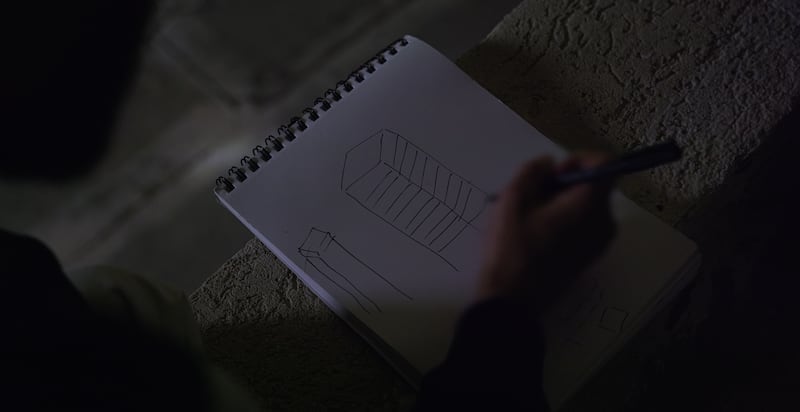
Naza is, to some extent, a film about Tel Aviv. While Abraham and his sources talk on the moonlit roofs, the interviewees’ voices digitally altered, the camera peers through windows to find residents going about their typical evening business.
One cannot help but think of Jonathan Glazer’s
The Zone of Interest. That director was, indeed, an executive producer of this film.
“That’s one way to look at it,” Abraham says. “Another way to think about it is that it’s an image of Tel Aviv as a city. Tel Aviv is considered to be Israel’s liberal centre. It’s a city that people usually do not associate with Netanyahu and not with the far right.
“It’s like the Israeli centre of the secular population – the population that is more liberal, that is in opposition to Netanyahu. Many of the intelligence officers and soldiers, if they could choose a city that would be most associated with who they are, it would be Tel Aviv. They are also part of Israel’s liberal elite, intellectual elite.”
That seems something of a contradiction. Here they are engineering slaughter on a medieval scale.
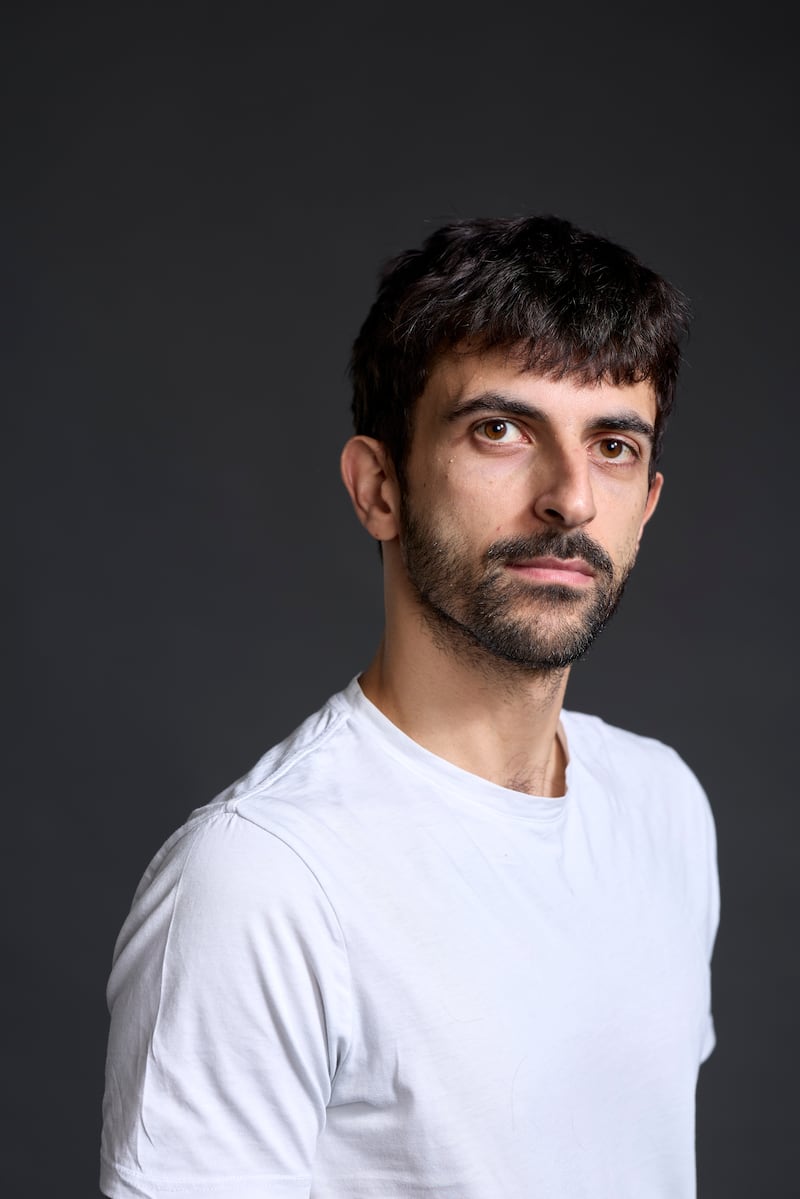
Film directors Yuval Abraham and Rachel Szor. Photograph: David Levene
“Gaza is primarily, first and foremost, the responsibility of Netanyahu’s far-right government, who was in power when this was all happening,” Abraham says. “So, this is not to let them off the hook, but what was so striking for me and really important to look at with this film is the extent to which Israel’s so-called centre left – the more liberal elements of Israeli societies – have played uncritically a role in the destruction of Gaza.
“Most of the Israeli pilots and most of the Israeli intelligence officers and most of the senior commanders signing off on air strikes generally come from that liberal side of Israeli society.”
These are insights you rarely get from news reports on this sprawling catastrophe. Abraham knows whereof he speaks. I had read that, at the age of 19, he was assigned to a position in the Israeli intelligence corps.
“I was supposed to be there,” he says. “I was assigned in the mandatory military service, as it says online. That’s true. I left. It’s not something that I’ve done. I left very early on. I never assumed my role.
“It was interesting for me also because, doing this film, it’s like the road not taken. This happened a long time ago. When I was 18 or 19. But when I was talking to some of these officers, it was, like, oh, I maybe could have become one of them if I hadn’t taken a different choice earlier on in my life.”
There are alternatives.
“There is always an alternative, even if it’s really difficult,” he says. “Israeli society is a very conformist society. When you grow up, it’s like the water you swim in, the military service. That’s part of why criticising the military, as we are doing in this film, is considered a taboo in Israeli society. That’s part of why the reaction against us is so harsh.”
He leans into the answer.
“But there is always a choice.”
Naza is in cinemas from Thursday, October 15th